 LineSheetFlow
A WORKED EXAMPLE FOR PAPER GOODS BRANDS
Stationery line sheet template for cards & paper goods.
Help a gift-shop buyer choose designs, understand your case packs and place a clear order. Start with six sample products, then make the catalog your own.
Finished samples are free. Editing and previews are free; downloading a PDF of your own products requires Pro.
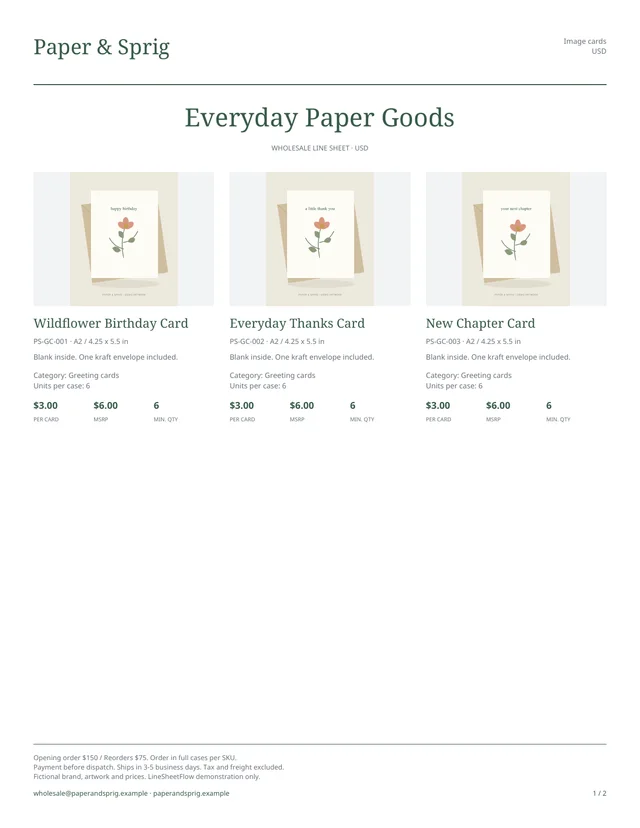
Show what the retailer is actually buying
A greeting card, a retail box of eight notecards and a case of four boxes are different quantities. Put the selling unit beside the wholesale price. State the case pack and minimum in those same units, then use specifications to explain what is inside a retail pack.
| Product / SKU | Wholesale / unit | MSRP / unit | Case pack & minimum |
|---|---|---|---|
Wildflower Birthday CardPS-GC-001 | $3.00 / card | $6.00 | 6 cards per case; minimum 6 |
Everyday Thanks CardPS-GC-002 | $3.00 / card | $6.00 | 6 cards per case; minimum 6 |
New Chapter CardPS-GC-003 | $3.00 / card | $6.00 | 6 cards per case; minimum 6 |
Botanical Notecard BoxPS-SET-001 | $9.00 / box | $18.00 | 4 boxes per case; minimum 4 |
Market List NotepadPS-NP-001 | $4.50 / pad | $9.00 | 4 pads per case; minimum 4 |
Olive Dot Grid NotebookPS-NB-001 | $7.00 / notebook | $14.00 | 4 notebooks per case; minimum 4 |
A boxed-set example: PS-SET-001 contains eight cards and eight envelopes in one retail box. At $9 per box, a case of four boxes costs $36 and contains 32 cards. Enter unit = box, case pack = 4, minimum = 4. Entering 32 as the minimum would mean 32 boxes.
Keep a separate SKU for each greeting-card design. Include the finished size, blank or printed interior, envelope and packaging details. A2 card size refers to the card; it does not set the PDF paper size. Choose US Letter or A4 separately for the catalog.
An opening-order minimum, such as the illustrative $150 in this sample, applies across the order. Put it in your trading terms. It is different from a six-card minimum for one SKU; LineSheetFlow displays these terms but does not enforce an online order minimum or collect orders.
TRY THE SAME SIX PRODUCTS
A starter kit you can actually import.
The CSV and six SKU-named PNG illustrations match the sample PDF. Use them to test the workflow, then replace the demonstration data with your own designs and terms.
Make your stationery line sheet in four steps
- Import the product CSV. Open the workspace, sign in and create a project. Import the file, check the SKU, wholesale, retail, MOQ, case-pack and unit mappings, then review and apply. For an Excel or Google Sheets file, export a CSV first.
- Match the artwork. Unzip the six PNGs and upload them with Batch upload photos in the Products step.
PS-GC-001.pngmatchesPS-GC-001. Upload the individual PNGs, not the ZIP. Use the front of each card or pack so buyers can distinguish designs. - Choose a layout and add your terms. Image cards help buyers browse a new collection. Case-pack pricing puts the unit and case totals side by side. Add your logo, contact details, lead time and opening-order minimum.
- Check every page. Select US Letter or A4 and preview the complete range. Verify the selling units, pack sizes and prices before using Pro to download your own PDF.
The CSV import and photo-matching guide shows the actual import screens. You can switch among all six layouts without entering the products again.
Keep a stockist’s prices consistent when costs change
The second sample uses a 10% customer discount and a fixed $8.25 quote for the notecard box. This demonstrates two pricing rules in the same catalog. Customer price versions and reviewed CSV updates require Pro.
| Product | Original wholesale | Original stockist price | Updated wholesale | Updated stockist price |
|---|---|---|---|---|
| PS-GC-001 per card | $3.00 | $2.70 10% off | $3.20 | $2.88 10% off |
| PS-SET-001 per box | $9.00 | $8.25 Fixed quote | $9.50 | $8.25 Unchanged fixed quote |
Keep the SKUs unchanged and import the update into the existing project. Review both price changes before applying them. The card’s case price becomes $17.28 for this stockist ($2.88 × 6). The box keeps its fixed quote until you edit or clear the override; the other four products and their matched images stay in the project.
Download the stockist PDF · before the update ↓See the customer price-list guide for the discount and fixed-quote workflow.
Questions about stationery line sheets
Is this an editable Excel or Word template?
The product CSV is editable in a spreadsheet. The PDF is a finished output example. Layouts are edited in LineSheetFlow; these downloads are not Word, InDesign or Canva template files.
Can I use my own card designs?
Yes. Replace the sample rows and upload your own JPEG or PNG images named after the SKUs. The supplied pictures are original demonstration illustrations, not photos of products for sale.
Can I take wholesale orders through the PDF?
The PDF shares your range and buying terms. Include your ordering email or website in the brand settings. The order worksheet offers blank quantity fields for writing by hand; it does not accept payments or submit orders.
Do all stationery brands use the same minimums?
No. Set quantities that match your packaging and terms. As a real-world reference, Studio Sunanda’s published wholesale terms list different case sizes for cards and notepads. This page’s fictional prices and quantities are a worked example, not an industry requirement or affiliation.
What Is a Wholesale Line Sheet? Examples & Checklist
A buyer-ready checklist for SKUs, prices, minimum orders and product details, with examples across different product categories.
Read the guide The import guideFrom product CSV to a line sheet
Organize variants, preserve leading-zero SKUs and match photos. Start with a downloadable product CSV example.
Read the guide The pricing workflowKeep customer price lists up to date
Work through discounts, fixed quotes and case prices, then review what changes when a new product spreadsheet arrives.
Read the guide