 LineSheetFlow
A PRACTICAL WHOLESALE GUIDE
What Is a Wholesale Line Sheet? Examples & Checklist
A buyer-ready checklist for SKUs, prices, minimum orders and product details, with examples across different product categories.
A wholesale line sheet is a product reference that helps a retailer decide what to order. It connects each product’s photo and SKU with its wholesale price, minimum quantity and buying terms. A buyer should be able to identify an item and understand the order requirements without searching through an email thread.
A finished wholesale line sheet, explained
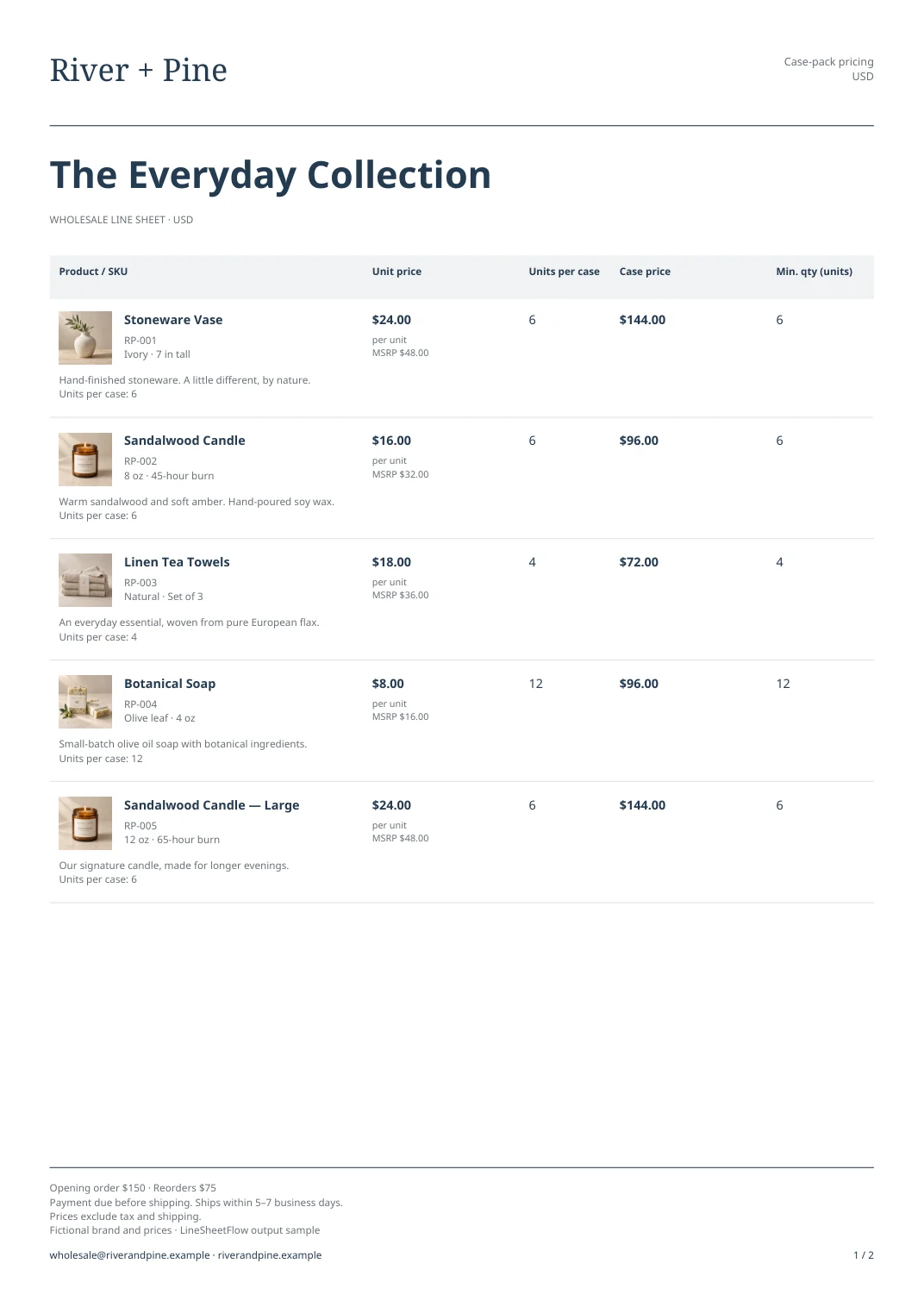
- Product / SKU: RP-001 identifies the Stoneware Vase and its ivory finish. Keep this identifier unchanged when updating the CSV.
- Unit price: $24.00 is the wholesale price for one vase; $48.00 is the suggested retail price. USD is stated at the top.
- Case pack: six vases per case at $24.00 each gives a $144.00 case price.
- Minimum quantity: six units means six vases, not six cases. The $150 opening-order minimum in the footer applies to the whole order.
- Terms and contact: the footer explains payment, dispatch, tax and shipping, then shows where a retailer can place an order.
SEE THE FINISHED FILE
Two complete catalogs you can inspect.
Real LineSheetFlow output using River + Pine, a fictional homewares brand. These finished PDFs are free samples; editable layouts are available in the workspace. Your own PDF downloads require Pro.
Line sheet, lookbook or order form?
A lookbook introduces a collection through photography and styling. A line sheet adds the practical information needed to buy it. An order worksheet leaves space for a buyer’s requested quantities and contact details. You can use these together: an attractive introduction, followed by a clear buying reference.
LineSheetFlow’s collection lookbook keeps prices alongside large photos. Its order worksheet has blank quantity and total columns for writing by hand; it does not accept online orders or calculate submitted orders.
The information to include
- Product name and SKU: give each sellable size, color or variation its own unique SKU.
- A clear photo: show the actual variant a retailer will receive. Use consistent crops and backgrounds where possible.
- Wholesale price and currency: say whether the amount is per item, pair, pack, meter or another selling unit.
- Suggested retail price: include MSRP or RRP when you have one. Leave it empty when it is not applicable.
- Minimum order and case pack: show how many selling units are in a case and the minimum number of units the buyer must order.
- Specifications and availability: include details that affect the buying decision, such as dimensions, material or lead time.
- Contact details and trading terms: tell buyers how to place an order and clarify shipping, payment, returns and any overall opening-order minimum.
Adapt the details to the product
| Product range | Useful details | Layout to consider |
|---|---|---|
| Apparel & accessories | Size, color, material and a SKU for each variant | Collection lookbook |
| Jewelry & homewares | Metal or material, dimensions, finish and packaging | Image cards |
| Food & beauty | Net weight, ingredients, shelf life and availability | Product details |
| Packaged goods | Price per unit, units per case and minimum units | Case-pack pricing |
| Textiles sold by length | Price per meter or yard, width and minimum length | Compact list |
These are buying references, not a substitute for required product labels or your product documentation. LineSheetFlow supports specifications plus up to four custom attributes per product. Choose the fields buyers actually need, and keep a detailed technical sheet separate when a product needs more space.
Make minimums unambiguous
For a complete paper-goods example, explore the stationery line sheet template. It includes individual greeting cards, boxed notecards and notepads, with the CSV, matching illustrations and finished PDFs.
Suppose a soap bar costs $4.50 wholesale, ships in cases of 12 and has a minimum order of 24 bars. Its case price is $54 and the minimum product spend is $108. Labeling only “MOQ 2” would leave the buyer guessing whether that means two bars or two cases.
In LineSheetFlow, enter the price per selling unit, set units per case to 12 and minimum order to 24. For products sold in cases, the minimum must be a whole multiple of the case size. An overall opening-order minimum belongs in your trading terms; it is separate from the product’s minimum quantity.
Check the buyer’s view before sharing
- Confirm SKUs, currency and prices against your source spreadsheet.
- Check every variant’s photo, selling unit and minimum order.
- Choose A4 or US Letter, then review each page for crowded descriptions or missing images.
- Check your contact details, lead times and trading terms.
- If the catalog is for a particular customer, verify the selected price version.
Compare the six line sheet templates, or follow the CSV preparation guide to start with your existing product table.
From product CSV to a line sheet
Organize variants, preserve leading-zero SKUs and match photos. Start with a downloadable product CSV example.
Read the guide The pricing workflowKeep customer price lists up to date
Work through discounts, fixed quotes and case prices, then review what changes when a new product spreadsheet arrives.
Read the guide