 LineSheetFlow
A PRACTICAL WHOLESALE GUIDE
Line Sheet vs Catalog vs Lookbook: What to Send Buyers
Compare buying details, product storytelling and order worksheets. See real PDF examples and choose what to send a new stockist or a repeat wholesale buyer.
A line sheet helps a wholesale buyer decide what to order: it pairs each SKU with a photo, wholesale price, minimum quantity and terms. A catalog presents a product range in more detail. A lookbook emphasizes photography, styling and the collection’s story. For a retailer ready to buy, send a line sheet; for an introduction, a catalog or lookbook can accompany it.
The names overlap. A catalog with clear wholesale prices and order requirements can also serve as a line sheet. Choose the information and layout around the buyer’s task, rather than the document’s label.
What belongs in each document?
| Document | Buyer’s question | Include | Try this layout |
|---|---|---|---|
| Line sheet | What can I order, at what price and quantity? | Photos, SKUs, wholesale prices, minimums and buying terms | Image cards |
| Product catalog | Which products and specifications fit my store? | Product range, photos, descriptions, materials and dimensions | Product details |
| Lookbook | How does this collection look and feel? | Collection photography, styling and concise product context | Collection lookbook |
| Order worksheet | Which quantities would I like to request? | Product references, buyer details and space for quantities | Printable worksheet |
A wholesale line sheet normally shows the seller’s trade price. MSRP or RRP is the suggested retail price and should be labeled separately. A customer-facing retail catalog may only show retail prices; confirm the recipient and price version before sending either document.
What should I send a wholesale buyer?
A new boutique considering your brand
Start with an image-card line sheet that shows the range clearly. Add a lookbook when styling or collection photography helps explain the products. Keep prices, minimums and contact details easy to find so the buyer can move from interest to a concrete selection.
A stockist placing a repeat order
Use a compact price list with familiar SKUs and current prices. If you have agreed a discount or fixed quote, send that buyer’s version. The customer pricing walkthrough shows how fixed quotes and percentage discounts behave when prices change.
A buyer ordering cases at a trade show
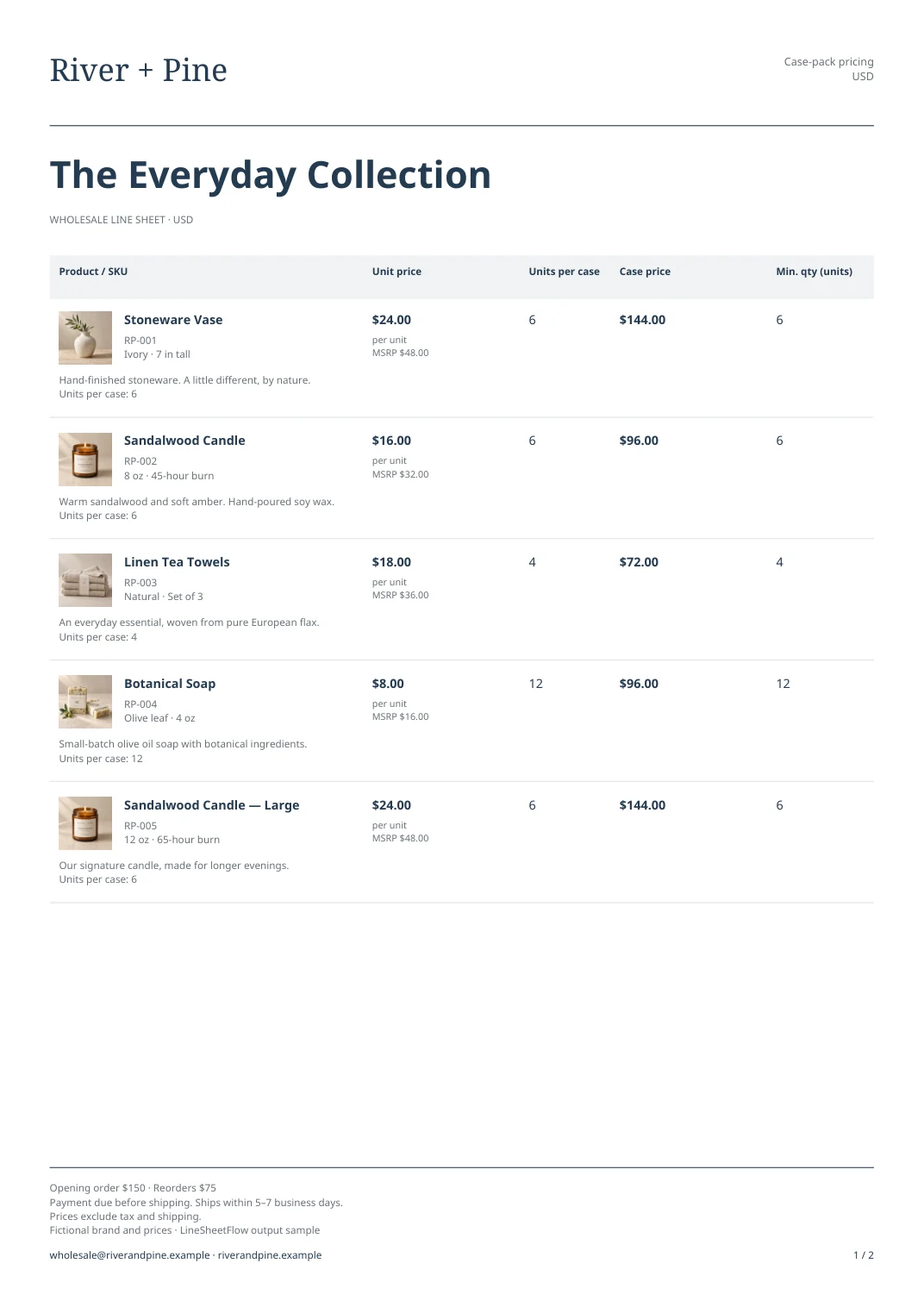
Use case-pack pricing so units per case, case price and minimum quantity are visible together. Add an order worksheet if buyers want to write quantities by hand. LineSheetFlow’s worksheet is a printable PDF; it does not submit orders, take payments from buyers or track stock.
SEE THE FINISHED FILE
Two complete catalogs you can inspect.
Real LineSheetFlow output using River + Pine, a fictional homewares brand. These finished PDFs are free samples; editable layouts are available in the workspace. Your own PDF downloads require Pro.
Can I make these from one spreadsheet?
Yes. In LineSheetFlow, every layout uses the same product data and photos. Import your Excel or Google Sheets product list as CSV, then switch between image cards, a compact list, a lookbook, product details, case-pack pricing and an order worksheet. You do not need to re-enter each SKU when you change layouts.
- Give every sellable variant a unique SKU and a clearly labeled wholesale price. Add retail price, selling unit, minimum quantity and case pack where relevant.
- Match product photos, choose a layout and add your logo, contact details and trading terms. Our CSV import guide includes a downloadable sample file.
- Check the recipient’s prices and every page in A4 or US Letter. Editing and watermarked previews are free; exporting PDFs of your own products requires Pro.
Does a lookbook need prices?
It depends on how you will use it. An editorial introduction can keep prices in a separate line sheet, while a buying document should make them easy to find. LineSheetFlow’s lookbook layout retains product prices alongside large photos, so it can serve both purposes.
Do I need a separate order form?
Only if it helps your ordering process. A line sheet can tell buyers to email SKUs and quantities to your sales address. A printable worksheet gives them somewhere to write those quantities. If you need a live shopping cart, inventory availability or automatic order processing, those require a separate ordering system.
Ready to check your document? Use the wholesale line sheet checklist for a field-by-field review, or inspect the complete stationery example.
What Is a Wholesale Line Sheet? Examples & Checklist
A buyer-ready checklist for SKUs, prices, minimum orders and product details, with examples across different product categories.
Read the guide The import guideHow to Make a Line Sheet from Excel or CSV
Organize variants, preserve leading-zero SKUs and match photos. Start with a downloadable product CSV example.
Read the guide The pricing workflowHow to Create Customer-Specific Wholesale Price Lists
Work through discounts, fixed quotes and case prices, then review what changes when a new product spreadsheet arrives.
Read the guide